 Skip to main content

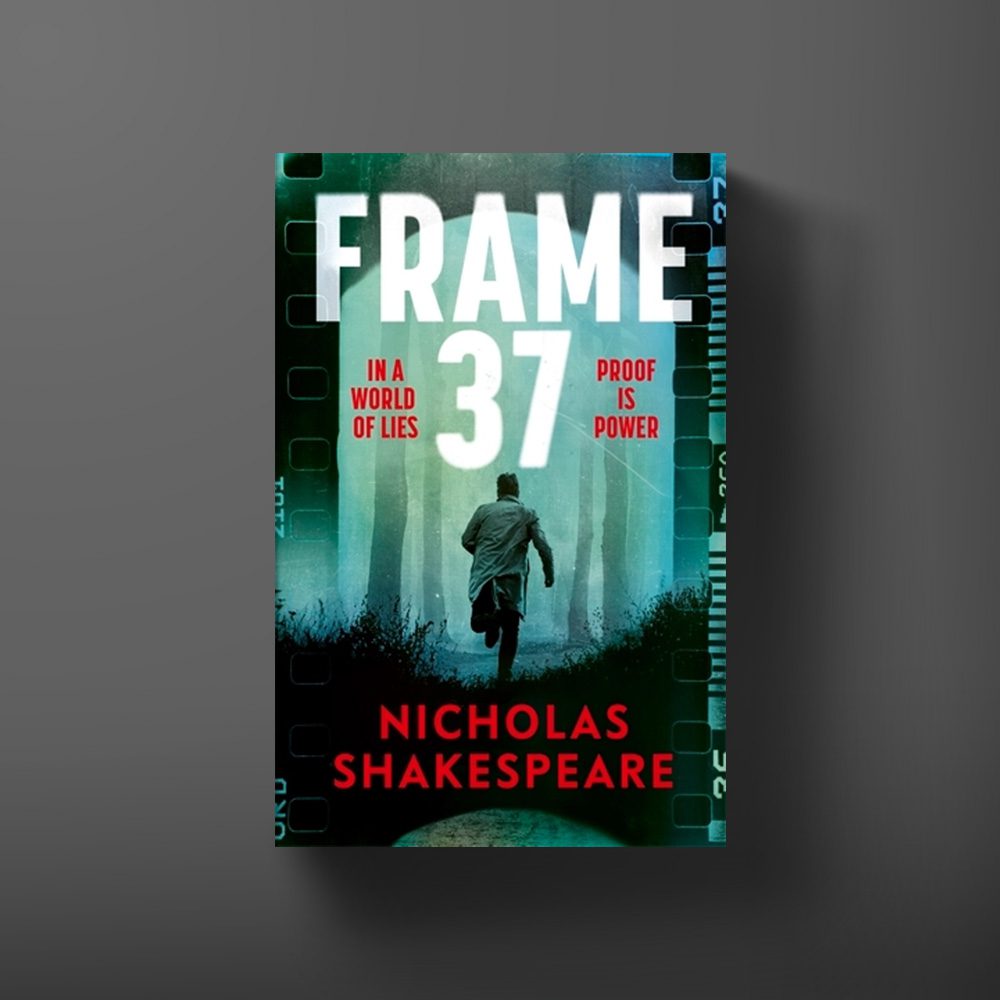
Join us for a deeper insight into this month’s James Bond Book Club pick, Frame 37, as we discuss it with the author, Nicholas Shakespeare.
Where did the title, Frame 37, come from?
On an old-fashioned analogue camera, a film roll of 36 negatives, if loaded carefully, could provide an extra shot. The heart of my thriller concerns what, potentially, was captured on this 37th frame: i.e. if a Leica lost for 40 years can be discovered with the film intact, then that film might provide unimpeachable evidence to prevent a violent and narcissistic rapist from becoming the most powerful man on earth. In a world where both digital photography and AI today question the integrity of virtually every image, it’s become noticeable that we are reverting to old-fashioned analogue film as a more reliable guarantor of the truth. In much the same way, we are falling back on “the old verities” of local journalism and vinyl records. Even as national newspaper circulations slump and fake news dominates the headlines, it seems ever more important for local journalists to continue reporting on their communities and holding local politicians to account.

Where did the central idea come from, of a presidential candidate with a skeleton in his cupboard?
I’d begun this novel in Tasmania in 2019 – in my beach-retreat equivalent of “Goldeneye”, where I have gone to write for 25 years – when my agent Clare Alexander rang from London to say that she’d had an approach from the Ian Fleming Estate. Would I be interested in doing a new authorised biography of Ian Fleming? Naturally intrigued and increasingly enthusiastic, I shortly afterwards had to put my novel on hold. But what is curious is how the plot I’d conceived, of a presidential candidate who’d been a sexual abuser, started to be mimicked by events unfolding in America, not least with the celebrated court cases of Brett Kavanaugh vs. Christine Blasey Ford and Donald Trump vs E. Jean Carroll. Two other seeds may have contributed. One was the drama of Dominique Strauss-Kahn, former head of the International Monetary Fund and at the time a shoo-in for the French presidency, who was arrested in New York in May 2011 for the alleged sexual assault on a hotel maid. By a strange quirk, a line from my first novel The Vision of Elena Silves was quoted six months later by Francois Hollande, the eventual successful candidate, when he announced his presidential bid in January 2012 at Le Bourget (“They fail who did not begin with a dream”) – except that Hollande believed he was quoting from another Shakespeare… The other seed was the discovery of a scarcely known incident in which Laura Bush, future wife of George Bush Jr., killed a fellow undergraduate in a car crash when she was seventeen. I reflected on how much effort must have gone into keeping this story out of the headlines and what would happen if you had a presidential candidate who had kept an even darker skeleton in their cupboard.
Did you have the plot mapped out before you began?
I tend to start my novels with a scenario that, for whatever reason, has got under my skin, a pebble that I’d like to extract from my shoe, as it were. The Vision of Elena Silves was inspired by one night in Portugal seeing the Coimbra convent where the last surviving witness of the Miracle of Fatima was still alive. I had a sudden image of a nun incarcerated by the Catholic church ever since she was a teenager, who had been inflicted with a knowledge of God, who suddenly wonders what would happen if she escaped the convent to look for the boy she’d been in love with, who’d had his own vision, a political vision. I wrote the novel to find out. The same with Frame 37. What unimpeachable evidence could possibly exist out there to stop a Trump-like shoo-in from becoming the US president?
The protagonist John Dyer is an ex-foreign correspondent who has appeared in two other novels, The Dancer Upstairs and The Sandpit. Did you feel the dangers which Raymond Chandler warned Ian Fleming about in having a serial character?
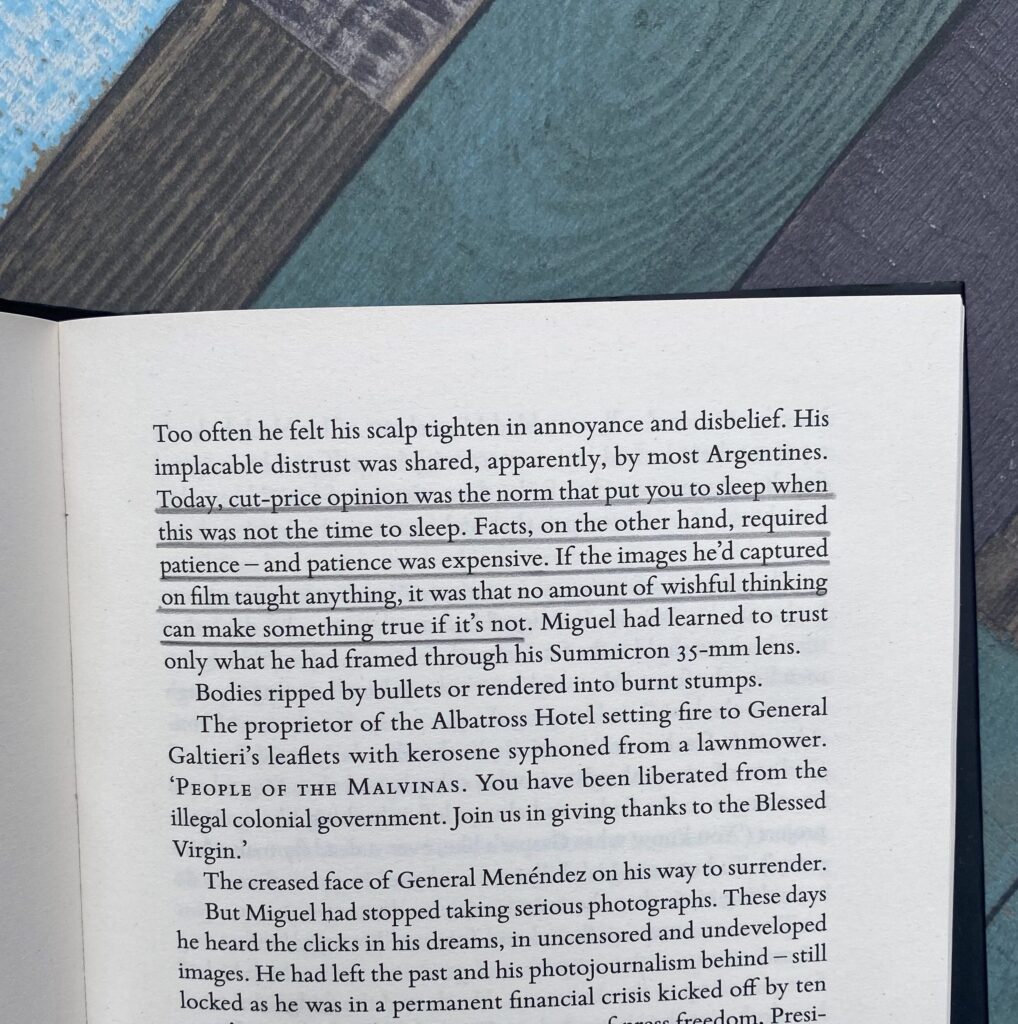
Originally, I never intended for John Dyer to be anything other than the waiter to serve the narrative of The Dancer Upstairs. He was a mere Latin American correspondent for a London newspaper that closes down its office in Rio. As an early Conrad reader – I remember Peter O’Toole and David Lean passing through Phnom Penh when we lived there, to film Lord Jim – I was probably influenced by Conrad’s regular device of the Marlowe figure who pops up again in Heart of Darkness. It’s strange how to be told a story at second-hand can, counter-intuitively, make the reader incline forward in their chair rather than lean back. In John Malkovich’s adaptation of The Dancer Upstairs, in which Javier Bardem plays the lead role, the camera acts as Dyer and goes straight into the action, onto Bardem’s face. But in Dyer’s second outing, The Sandpit, set in Oxford, I decided to shift Dyer towards the centre of events and so had to provide him with extra biographical details (rather as Fleming was forced to do with each Bond book, scraping bits of himself into his protagonist until we finally discover that Bond was Scottish and went, like Fleming, to Eton). By the end of The Sandpit, Dyer had become established in my head and I could easily picture him using his journalistic talents to track down the story behind Frame 37. The problem is that with each outing he needs more background. At the same time, he is hemmed in by what we already know about him. That is to say, he becomes deeper in one sense but narrower in another, in that the fictional opportunities he is able to offer are firmly hidebound by his own experience and times. The danger becomes that the author forgets certain salient details, as le Carré did when he brought back George Smiley – not appreciating that he’d be over 100 by this time.
Were you conscious of writing a political thriller – and if so what did unusual demands or restraints does that impose on a novelist, if any?
Much as I enjoy them, I confess to not being as dedicated a serial reader of political or spy thrillers as I should be. The first fiction I am conscious of responding to was a retelling of King Arthur and the Knights of the Round Table. I was five or six when my mother came into my room in Port Dickson on the Malayan coast to find my face marked with tears. “What’s wrong?” I looked up glitter-eyed. “Launcelot is dead!” Thereafter, I sought out stories that promised the same impact. Buchan, Shute, Greene, MacLean, Innes, le Carré, not to leave out Fleming. Like many writers I know, I started writing once I’d exhausted the supply. However, I’m also tremendously conscious that I don’t necessarily abide by the formulas, whatever they may be, of the genre novel. I’m with Bruce Chatwin on this – that the only true story is a good story. How one gets there to tell it is different for each writer. I have an undiminished admiration for Graham Greene who plundered whatever came to hand – childhood tales, detective stories, political thrillers, spy thrillers, travelogues – without becoming straitjacketed or restrained by any single discipline.
‘There’s no such thing as an ex-journalist.’ Dyer seems to rediscover his passion for the craft by revisiting his youth. How did you approach constructing his backstory?
In The Dancer Upstairs and its sort-of sequel The Sandpit, Dyer developed from being a foreign correspondent with a chance to come out of Latin America on a high – to being a single father who’d traded in journalism for charity work/teaching English/writing a book about the Amazon, and has exchanged Rio for Oxford, where he himself was at prep school. I had myself moved with my wife and two small boys from Tasmania to Oxford and I unashamedly exploited the situation I found myself in: an autumn father surrounded at the school gates by younger, wealthier, more international parents who had fingers in important pies like banking and Intelligence. Dyer may have turned his back on journalism, but he couldn’t blind himself to a good story when he saw it – he couldn’t turn off his reporter’s eye. I’d been interested in the elusive promise of nuclear fission. When I was lucky enough to get a Visiting Fellowship at All Souls, it gave me a passport to speak to the topmost brains in this field. It was during a discussion with Steve Cowley, then President of Corpus Christi College and now Director of the Princeton Plasma Physics Laboratory, that we came up with a plausible idea for cracking nuclear fission – modelled on nothing more rarefied than a bog-standard prep school football. Then, when I was hunting around for a lead character for Frame 37, I realised there was still a year or two of Dyer’s earlier life that hadn’t been accounted for, which I seized upon, and sent him as a graduate student to Ann Arbor, on a course I had once failed to be accepted for. By chance at a Cambridge college reunion not long ago, I rediscovered a school friend who had been awarded the very fellowship I’d unsuccessfully applied for. He was able to describe for me in detail Ann Arbor as it would have been in 1981. Just like Fleming and Bruce Chatwin, whose biography I also wrote, I’m an obstinate stickler for not writing about places unless I’ve been to them. I had to draw on all Dyer’s resources as an ex-journalist to invent Ann Arbor and Michigan. It’s the only place in my novels I haven’t visited.
Do you think pausing this project to research Ian Fleming for your biography had an effect on the finished novel?
I’m hugely grateful to Ian Fleming for having allowed the world the chance to catch up with my plot. In rather the same way, although on an infinitely larger scale, the film of “Dr No” came out just at the time of the Cuban Missile Crisis (1962), which the movie gave every impression of appearing to dramatise. During the five years that I needed to put aside to write Fleming’s life, not only did the central device in Frame 37 – of a presidential candidate with a violent sexual past – become more contemporary and feasible, but so did the possibility that analogue film and local journalism might prove to be fiercer watchdogs of the truth than AI and fake news. This was not so obviously the case back in 2019.

What kind of specialist research did you need to do in writing about a US intelligence assassin and modern surveillance?
Growing up abroad as a diplomat’s son, I met several spies or former spies, including Greene and le Carré (who had been a friend of my parents at Oxford), both important influences as I’ve said. But I never benefited significantly from their indiscretions or knowledge. I need to do the fieldwork myself. (In Peru, when researching the Shining Path revolutionary movement for The Dancer Upstairs, I was conscious of the irony that it was the US Embassy in Lima, whose agents were famous for never leaving the capital, who were mustard keen for me to share my material). In Frame 37, I have a US Delta Force-trained assassin. He is based on a man I met by chance in Tasmania 25 years ago after I discovered that I had a doppelganger, N(evin) Shakespeare, an electrician who lived in Tasmania’s north-west. Nevin put me in touch with one of his clients, who, he said, boasted that “he’d once had Colonel Gaddafi in his cross-sights”. Fascinated, I sat in this alleged assassin’s bungalow and wrote down everything he told me about his years in Delta Force, operating in Peru, the Yemen, Libya. I put aside the eight-pages of notes and forgot about them until, in 2023, I needed a state assassin for my story. I then remembered this interview. It turned out to provide everything I required and more. By and large, fictional characters and the dramatic situations novelists like to put them in are remarkably unaltered from the days of the Odyssey. Technology stands out as perhaps the one area where authors need to show a passable command in order to create their smoke and mirrors. That said, surveillance techniques are so fast changing that a novelist can never hope to be up to date. In Frame 37, I depended on a chance encounter that my wife had with another local dog-walker who turned out to work in the “information security business”. I gave him a call and he divulged some details which I was glad to use in Frame 37 – including the, for me, riveting story of how facial recognition cameras at JFK airport were once capable of 100% success, but the time required to process the data led to five-hour queues at the airport, so the pace was speeded up – yet this only allowed for a 45% hit rate. I’m sure they’ve solved this glitch by now, but it gave me an aperture that sounded at least plausible to exploit in my novel. You only need an aperture. As the owner of the Leica must have known when he took that presidentially altering shot in Frame 37.
Ian Fleming’s advice for writing a thriller was simply ‘get the reader to turn the page’. In your own words, how do you write a thriller?
Crikey, that’s a tough one. One of several personal discoveries I made when researching Fleming’s life was the role of my grandfather, a prolific writer and teacher called S. P. B. Mais, in lending a distant hand to Fleming’s own thriller-writing methods. SPB, as he was known, had taught Fleming’s friend Alec Waugh at Sherborne, and got published his scandalous first novel The Loom of Youth (1917), after giving Waugh his recipe for successful writing: to work five hours a day and write 2,000 words. It was SPB’s inflexible rule to be a workman and keep to a routine from which nothing must be allowed to deter you. Waugh took this to heart and passed it on to Fleming (along with a life-shifting recommendation to visit Jamaica). What I envy in Fleming are his natural command of short sentences, his lucidity, his infectious energy and pace. I like his image of each chapter as “a wave to be jumped as we race with exhilaration behind the hero like a water-skier behind a fast motor boat.” Of course, you try to do this whenever you can, but I fall over far too often. As a result, my novels take much longer – three years as against Fleming’s two to three months. In this respect, I find myself closer to the timeframes of Graham Greene and John le Carré. Perhaps every writer, though, has their own Personal Best timespan, as it were. Many of the writers I admire were gifted at least once in their lifetime with a book they wrote at speed. The Spy Who Came in From the Cold allegedly took le Carré seven weeks. Stendhal wrote The Charterhouse of Parma in 52 days. Edna O’Brien wrote The Country Girls in three weeks… I still hold to the dream of one day completing a book in “Fleming time”.
We hope you enjoyed this interview! Be sure to pick up this month’s excellent thriller, Frame 37, if you haven’t already. Thank you very to Nicholas Shakespeare for taking the time to talk to the James Bond Book Club.
We’ll be back next month to announce our October pick…