Interview: Raymond Benson On The Hook and the Eye

We sat down with Bond novelist Raymond Benson to talk all things Felix, Fleming, and The Hook and the Eye. Read on to learn more about the latest adventures of James Bond’s trusted friend and ally.

After a long break from writing for Ian Fleming Publications, how does it feel to be back with a brand new story?

It feels great! For one thing, the people at Ian Fleming Publications are fabulous to work with. Both now and back when I was doing the Bonds in the late 1990s and early 2000s when there was a completely different team in place. In the past I was fortunate to work with Peter Janson-Smith, the man who was Ian Fleming’s literary agent. He not only acted as editor and mentor in a professional capacity to me, but he was also my friend. I miss him a great deal. That said, I love working with you lovely folks at IFPL now. It’s been a uniquely rewarding experience doing The Hook and the Eye with everyone. I’m glad to be back.

Black and white photograph of author Raymond Benson, a middle aged white man wearing glasses.

How did you find reconnecting with Felix, was it challenging at first or did it feel like returning to an old friend?

I love Felix. I always have, ever since I first read Fleming’s books as a kid in the 1960s. Somehow I identified with him, maybe because he was a Texan (I was born and raised in Texas, too). And while several fine actors portrayed Felix in the films, we’ve never seen Fleming’s literary character on the silver screen. For one thing, in four of the six books Fleming wrote in which Felix appears, he has a prosthesis for a right hand. But there’s also a joviality to his personality that’s only in the books. He’s very much a “kidder” and he always stays upbeat. Having the opportunity to get to know Felix better and place him in his own adventure was indeed like returning to an old friend—and that includes revisiting the Bond universe itself.

What was the very first thing you did regarding your research for this project? 

The first thing I did was re-read all the Felix passages in the Fleming books. I’ve read the novels numerous times throughout my life and I know them well. I just wanted to reacquaint myself with Felix’s speech, the way Fleming presents him, and also note the details of Felix’s life and history that Fleming gave us. There isn’t a lot about Felix prior to his meeting Bond in Casino Royale. But there are tidbits and clues… enough for me to take and then develop into something bigger. I then wanted to know exactly how his prosthesis would affect his life. Fleming doesn’t give us much info about the “hook.” When I first read the books, I pictured in my head a pirate hook. That, of course, is not what it would have been. In the time period I set the story—the early 1950s—Felix’s prosthesis would have been supplied by the Veterans Administration and similar to what actor Harold Russell had in the movie The Best Years of Our Lives. I sought out a prosthetics doctor who provided a lot of the information I needed to give readers a better understanding of how Felix deals with his disability and still manages to be something of a detective hero!
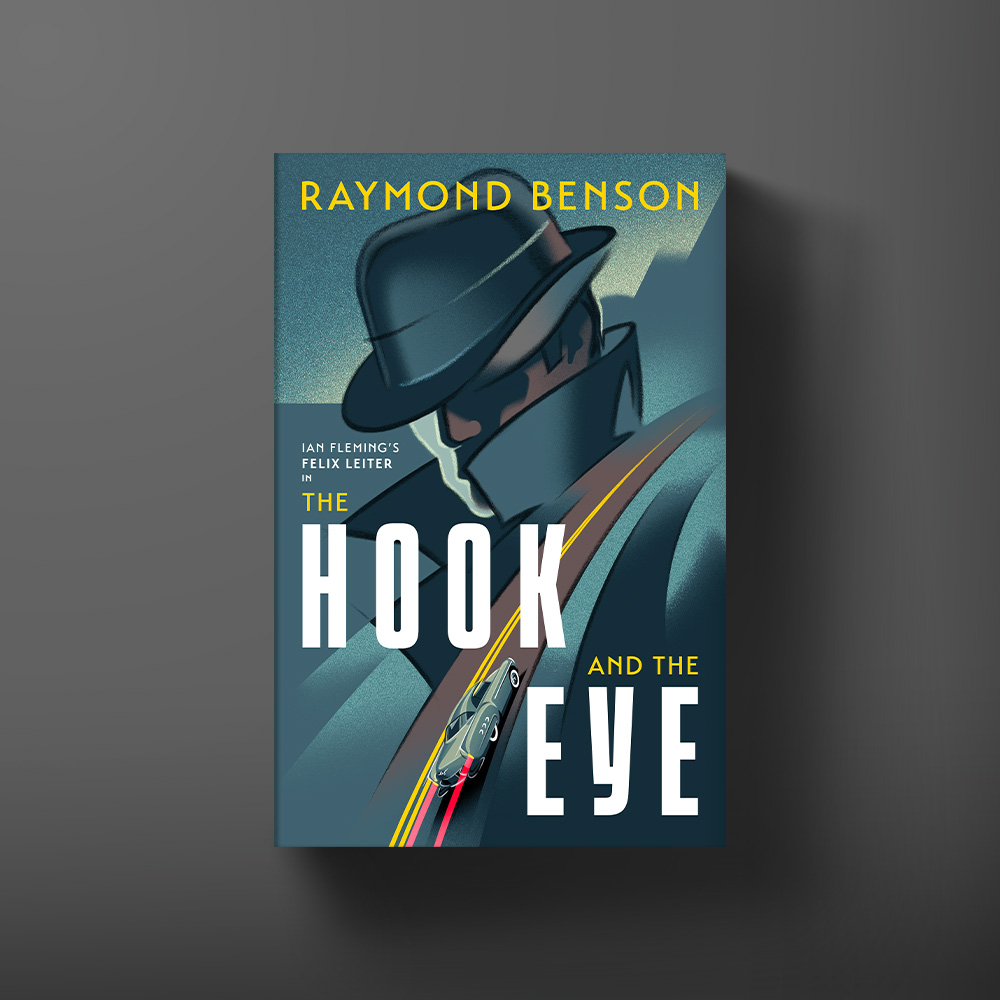
Book cover for The Hook And The Eye by Raymond Benson.

Felix Leiter is usually seen as a loyal ally to James Bond, but in this novel, he’s on his own. How did you approach writing from Felix’s perspective, especially in the context of a detective story as opposed to a Bond adventure?

I was certainly inspired by the pulp noir novels of the 1940s and 1950s, and certainly by Fleming’s 1950s-era novels. There’s a certain vibe that you get when you read those things. I’m not saying The Hook and the Eye is a pulp noir crime novel, but there are elements. I also wouldn’t call Fleming pulp noir nor “hard-boiled.” He was his own unique thing. I suppose I’ve fashioned the book more in his direction. I wanted it be as if Fleming had somehow developed an American voice and written the book himself in 1953. One thing that helped me immensely was the decision to write the novel in first person, from Felix’s perspective. This also helps generate that noir sensibility, but it also allows the reader to get to know Felix very, very well! We’ve never had a Bond novel written in first person, save for The Spy Who Loved Me, and that narrator isn’t Bond! So that’s a big difference in the way I’ve approached a Felix Leiter detective story as opposed to a James Bond adventure.

This project has been in the works for a long time. How different is the end result from your original concept?

Not very different at all! I’m not sure this is relevant, but way back in the late 1980s the very first novel I ever wrote was about a private detective who had a prosthesis. He wasn’t Felix Leiter. He was a different guy, but similar enough that down in my subconscious I was maybe thinking he was my version of a Felix Leiter. The title of the book was, coincidentally, Hook and Eye, Inc., as that was the name of the character’s detective agency. The story, locations, and time period were completely different from The Hook and the Eye. Peter Janson-Smith read the book and gave me some good feedback, but he agreed with me that it was the proverbial “first novel” and belonged in a drawer, never to see the light of day again! But it was a learning experience, and perhaps Peter saw then that, for future reference, I could begin a novel and, more importantly, finish it. Anyway, the current “true” conception of a Felix Leiter novel began after I had done my Bonds, which finished up in 2002. I wanted to see a Felix book in Fleming’s timeline that addressed his life and work in the early 1950s. The notion had come up occasionally in conversation with you at IFPL since that time, but doing a project like that just wasn’t in your plans then. Now it is! Last May 2024 I pitched the concept to Simon Ward, and that evolved into a full blown written proposal and outline, after which I received the green light. The concept and story hasn’t changed since. I suggested the title, The Hook and the Eye. I never meant for that to echo the title of my long lost unpublished first novel, but it better fits this one.  

Aside from having a Texan background, are there any similarities between yourself and Felix, either in terms of personality, values, or life experiences? How much of yourself do you see in him, and did that influence your writing of his character?

Whenever any author uses a first person narrative, I believe a touch of the author’s own voice goes into that of the narrator. I don’t think it can be helped. I think I know exactly how Felix would sound in real life because I knew and know men like him. I don’t think Felix has an exaggerated Texas drawl. He spent time in Europe and Washington DC. His accent would be tempered, much like mine. My Texas drawl was drilled out by being in theatre for so many years! I left Texas in my early twenties and moved to New York City. I have lived in other places in the north since then and now the Chicago area. Maybe Felix talks like I do, perhaps slower. As for other character traits… I’m sure my values match Felix’s, but we are of different generations. Felix would have been in my father’s generation, having served in World War II. That, in and of itself, makes our world outlooks markedly different. Felix did military service and worked in government afterwards—all that is foreign to me. But I know enough about those things and I have known men who have had those life experiences. It’s more about Felix’s personality. That is closer to me. I like to think I’m as upbeat as Felix. When I’m with my pals I joke around like Felix. I enthusiastically praise whatever food and drink we’re having in Felix fashion. I’m not the heavy drinker or smoker that Felix is, that’s for sure, but, like him, I’m a jazz fan! Incidentally, there’s a member of my family who was born without a right hand. So, there’s that familiarity, too. Also relevant to my own life are the locations. I’ve lived in or been to all of the locations in the story. A certain national park plays a big part in the tale, one that I’ve visited numerous times because it was in close proximity to where I grew up. The route of Felix’s road trip is one I traveled a few times. The settings in The Hook and the Eye are some of my favorite places in America.

Your attention to historical detail, particularly with the placement of the story between Live and Let Die and Diamonds Are Forever, adds a level of authenticity to the narrative. What were the challenges in fitting The Hook and the Eye into this established timeline, and how did you integrate the social and cultural landscape of 1952 into the plot?

John Griswold’s 2006 book, Ian Fleming’s James Bond: Annotations and Chronologies for Ian Fleming’s James Bond Stories speculated when in the real world that Fleming’s books took place. John used clues from the books and other factors and came up with believable conceits. He determined that Live and Let Die actually took place in January and February 1952. Diamonds Are Forever was in late summer 1953. Thus, my story for Felix could take place throughout most of 1952. This was fortunate for me because some real world events occurred that year that I felt could play into the tale. Once I committed to that setting, it became a matter of researching the period, especially the American landscape at the time in terms of roads, restaurants, and hotels that Felix would be using. I had to approximate what did and didn’t exist in 1952 in certain cities that are in the story. I was born in the 1950s. It really wasn’t too far removed from my own memories. The small town in Texas where I grew up was always at least five years behind the times of major urban areas like, say, New York… or even Dallas.  There are a lot of places in the States, especially in rural areas, where remnants of the past still exist. Even today you can visit small towns in America and find a Main Street that was built in the 1930s or 1940s with vintage movie theaters, retail businesses, diners and coffee shops, and offices. Sort of a ”lost Americana” that’s hiding in plain sight. That’s what I was interested in conveying. When I could, I used real places that might have been prominent in 1952 but are now either a shadow of what they were or, usually, completely gone. I also had to be mindful of what things cost then. Then there were the social mores that existed then. All the smoking. The drinking. Repressed sex. The burgeoning jazz scene. The Cold War political environment. All of this plays into The Hook and the Eye.

Without giving too much away, how did you go about developing Felix’s love interest/sidekick, Dora? What can readers expect from her?

Well, to talk too much about her would indeed give a lot away! I suppose I was thinking about the old films noir that had femmes fatale. (A femme fatale in those old films was usually a bad woman who led an otherwise good man to his doom.) I wanted someone that evoked that kind of character… but mind you, that doesn’t necessarily mean that Dora is a femme fatale. I wanted to give her an air of mystery that is compelling for Felix. Is she bad? Is she good? I’m hoping that she will keep the readers guessing, just as she keeps Felix guessing.   

There is so much to love about Felix as a protagonist. What do you hope readers enjoy most?

I’m hoping that readers will connect to Felix’s personality and get to know him as a fully drawn character. The positive feedback I’ve received so far from beta readers, editors, and the IFPL board seems to concentrate on Felix himself and the voice I’ve given him. The mystery-melodrama story/plot is also something a bit different for the Bond literary universe, but I believe it’s something Fleming might have come up with had he decided to write a Felix Leiter novel himself back in the 1950s. At least I’d like to think so.

Find out more about Raymond’s writing process in our Hooked on Leiter video series.
Hooked On Leiter: The Video Diary

Go behind the scenes of Felix Leiter’s adventures in The Hook and the Eye, with our exclusive video series, Hooked on Leiter. Author Raymond Benson takes you through each episode and gives insight into his writing process and inspiration. Be warned… each episode contains spoilers.

The Hook and the Eye paperback edition and ebook are out now at the ianflemingshop.com.

Fleming’s Felix: From The Beginning

Raymond Benson gives us an insight into the life and origins of Felix Leiter.

I love Felix Leiter. Always have. Ever since I first read Ian Fleming’s novels in the 1960s. While it was certainly the character of James Bond who lit a fire under me at a very young age, I identified with Felix. After all, Felix was a Texan. So was I. In the premiere book, Casino Royale, Bond reflects that “good Americans were fine people and that most of them seemed to come from Texas.”

Where did the author find his inspiration for Felix Leiter? We really don’t know. Felix’s first name was one of the middle names of Fleming’s longtime friend, John Felix Charles Bryce (but everyone knew him as “Ivar”). The surname came from Fleming’s Washington, DC friends, socialites Tommy and Marion “Oatsie” Leiter. Neither of them were Texans. Did Fleming know any Texans? I am not aware of any evidence to that effect.

Hardback book cover for Casino Royale by Ian Fleming, designed by Michael Gillette.

Unless one has read Fleming’s books, a Bond fan might not know the “real Felix.” While several fine actors have portrayed the character on film, a faithful incarnation of Fleming’s Felix has never been seen.

Allow me to paint a portrait of Ian Fleming’s Felix Leiter. Felix is Bond’s closest ally in six of the novels. At first, he’s with the CIA. After Felix loses a right arm and a leg to a shark in Live and Let Die, the CIA lets him go; however, he then finds work with Pinkerton’s Detective Agency. Felix remains with Pinkerton’s until Thunderball, in which Allen Dulles (the CIA chief) puts Felix on the reserve force. Felix is again placed on the reserves in The Man With the Golden Gun.

When Bond meets him in Casino Royale, Felix is about thirty-five. He is tall and thin, and he wears his clothes loosely from his shoulders like Frank Sinatra. Although his movements and speech are slow, Bond gets the feeling that there is plenty of speed and strength in Felix, and that he would be a “tough and cruel fighter.” Fleming goes on to describe him in Chapter 7:

‘As he sat hunched over the table, he seemed to have some of the jackknife quality of a falcon. There was this impression also in his face, in the sharpness of his chin and cheekbones and the wide wry mouth. His grey eyes had a feline slant which was increased by his habit of screwing them up against the smoke of the Chesterfields which he tapped out of the pack in a chain. The permanent wrinkles which this habit had etched at the corners gave the impression that he smiled more with his eyes than with his mouth. A mop of straw-coloured hair lent his face a boyish look which closer examination contradicted.’

One of the ties between the Englishman and the American may be that they enjoy being barroom rivals. There is almost always an obligatory scene in which the two visit a bar and drink themselves silly. In Casino Royale, Bond educates Felix on the making of a “real” martini, and Felix remembers the formula in subsequent novels. In Thunderball, Felix seems to have studied martinis thoroughly, for he, in turn, educates a barman in a Nassau hotel on the ingredients of that real martini. Felix knows when he’s being had; the martinis at the hotel are served with inadequate portions of liquor. Felix explains to the barman: “… here’s one who’s dry behind the ears. A good barman should learn to be able to recognize the serious drinker from the status-seeker who wants just to be seen in your fine bar.”

Kingsley Amis, in The James Bond Dossier,seems to think that Felix has no personality. Nonsense! (Sorry, Kingsley.) Felix’s personality is clearly revealed in his manner of speech and the subjects about which he speaks, as well as through several of the character’s idiosyncrasies. For instance, Felix is a jazz fan, and he escapes a nasty scrape in Live and Let Die by “arguing the finer points of jazz” with his black captor. Felix tells Bond many anecdotes about America while giving him guided tours of New York, Saratoga, or Florida. He and Bond have a good laugh at the quaint citizens of St Petersburg, and they take pleasure in complaining about the commercialism of the Bahamas’ hotels.

Felix is actually a bit of a goofball! He is so buoyant that the sun always seems to shine on him when he’s around Bond. Even after his mishap with the shark, Felix retains his upbeat humor. He’s the kind of joker who comes up behind Bond (in Diamonds Are Forever), sticks his hook against Bond’s back, and says, “All right, Limey. Take it easy unless you want lead for lunch.”

Most importantly, though, is the fact that Felix reinforces the theme of Friendship running through the series. The bond between the two men is extremely heartfelt. Felix Leiter, of all of Bond’s allies, brings to the books a warmth and joviality which is missing most of the time.

When Bond first encounters Felix in Casino Royale, the Texan is amiable and boyish. Fleming succeeds in giving the character a personality that is distinctly American. But the CIA man is a mere shell of what is to come. Not much is revealed about Felix in Casino Royale, but he is an immediately likeable figure. Fleming was wise in using Felix as the “cavalry to the rescue” when Bond loses all his money at the baccarat table.

Felix is further developed in Live and Let Die, where he has a strong supporting role. His cheeriness is an excellent complement to Bond’s seriousness, almost a breath of fresh air. Felix acts as Bond’s guide to America, and much of Fleming’s sense of humor is revealed in the Texan’s speeches: “You can get through any American conversation,” advised Leiter, “with ‘Yeah,’ ‘Nope,’ and ‘Sure.’ The English word to be avoided at all costs,” added Leiter, “was ‘Ectually,’” Bond had said that this word was not part of his vocabulary.

The friendship between Bond and Felix comes to fruition in this second novel. From the first chapter, in which the American surprises the Englishman by greeting him in a hotel room, to the tragic incident in which Felix almost loses his life to a shark, the men are inseparable. They barhop through Harlem together, sharing meals, conversation, and clue-gathering. Despite their differences in background, the men hit it off as if they’ve been friends since childhood. Bond seems to depend on this alliance with a male friend—it means more to him, sometimes, than his relationship with any woman in the novels. Bond even has trouble keeping the emotion from choking his voice in Chapter 17 when he learns that Felix, after having lost half an arm and half a leg, will live after all.

‘Bond’s heart was full. He looked out of the window. “Tell him to get well quickly,” he said abruptly. “Tell him I miss him.”’

Interestingly, Fleming killed off Felix in the first draft of the novel. It was the author’s American literary agent, Naomi Burton, who objected and talked Fleming into keeping Felix alive. She recognised the appeal of the character.

One of the highlights of Diamonds Are Forever is Bond’s reunion with Felix. Bond seems to remove his cold, stone-faced exterior when he’s around the Texan. Their tight friendship is apparent in their conversation and actions. Bond again allows some emotion to reveal itself when he says goodbye to Felix toward the end of the novel in Chapter 21:

‘Bond felt a lump in his throat as he watched the lanky figure limp off to his car after being warmly embraced by Tiffany Case. “You’ve got yourself a good friend there,” said the girl.

“Yes,” said Bond, “Felix is all of that.”’

Felix accompanies Bond to Saratoga and again pops up in the nick of time in Las Vegas. Now Felix is working for Pinkerton’s Detective Agency, “The Eye That Never Sleeps.” Felix does not seem bitter at all about carrying a steel hook for a right hand or limping through life with a wooden leg. He is as good-humored as ever. Perhaps this conscious negation of his physical disabilities is one reason why Felix remains a useful friend to Bond. Their reunion on the streets of New York is a joyful moment: they immediately proceed to their usual form of entertainment, i.e., eating and drinking. Besides procuring Bond’s drinks, Felix takes the liberty of ordering the Englishman’s meal. Felix is once again very helpful as Bond’s tour guide. He “mansplains” everything Bond needs to know about the Saratoga race track, Las Vegas gambling statistics, and American life.

The character appears only briefly at the end of Goldfinger, again in the form of cavalry to the rescue. He saves Bond’s life and the Englishman admits that Felix is always good at doing so. Felix, who still works for Pinkerton’s, is the same cordial character who is so refreshing to have around. It’s too bad his appearance is so brief in the book.

Hardback book cover for Thunderball by Ian Fleming, designed by Michael Gillette.

Felix has one of his biggest roles in Thunderball. The alliance between Bond and Felix is the tightest it has ever been. The loyalty these two men have for each other is one of the warmest qualities of the book—the sequence in which Bond meets the CIA agent at the airport and realizes it’s none other than Felix is an uplifting moment. Then it seems all they want to do is drink each other under the table after gorging themselves with meals. Describing the “chopped tenderloin of beef” at the Royal Bahamian, Nassau in Chapter 12, Felix complains, “This is hamburger and bad hamburger. The French onion rings were never in France, and what’s more, they’re not even rings. They’re oval.”

Bond and Felix constantly kid each other, much like how I understand the relationship between Ian Fleming and his American friend, Ernest Cuneo, would have played out. For example, in the following Chapter 14, the men are using the cover of a property-seeking English businessman and his American lawyer when they meet in a hotel restaurant:

‘Bond joined Leiter at a corner table. They both wore white dinner jackets with their dress trousers. Bond had pointed up his rich, property-seeking status with a wine-red cummerbund. Leiter laughed. “I nearly tied a gold-plated bicycle chain round my waist in case of trouble, but I remembered just in time that I’m a peaceful lawyer. I suppose it’s right that you should get the girls on this assignment I suppose I just stand by and arrange the marriage settlement and later the alimony.”’

Felix doesn’t seem to have any bitterness about the loss of his right hand and leg. Toward the end of the book in Chapter 22, the Texan insists on joining Bond in the underwater ambush of Largo’s men:

‘Felix Leiter interrupted. He said obstinately, “And don’t think you’re going to leave me behind eating Virginia ham. I put an extra foot-flipper on this”—he held up the shining hook—”and I’ll race you over half a mile any day, gammy leg and all. You’d be surprised the things one gets around to improvising when someone chews off one of your arms. Compensation it’s called by the medics, in case you hadn’t heard about it…”

Leiter turned to Bond. “You goddam shyster. Thought you were going to leave your old pal behind, didn’t you? God, the treachery of you Limeys! Perfidious Albion is right, all right.”

Bond laughed. “How the hell was I to know you’d been in the hands of rehabilitators and therapists and so on? I never knew you took life so seriously. I suppose you’ve even found some way of petting with that damned meathook of yours.” Leiter said darkly, “You’d be surprised. Get a girl round the arm with this and you’d be amazed the effect it has on their good resolutions.”’

The character’s final Fleming appearance is in The Man With the Golden Gun. Although there is no traditional drinking scene between Bond and Felix (a disappointing first), the sequences in which the Texan appears are high points. As usual, Felix pops up in the nick of time at the novel’s end, clearing the way for Bond to clean up the business at hand. And again, as usual, Felix is hurt and can’t participate in the final battle. Felix escapes this adventure by breaking his one good leg. Then, in a half-kidding, half-poignant moment in Chapter 15 as he leaves the hospital on crutches where Bond is under medical care, Felix tells Mary Goodnight:

‘“Okay, Miss Goodnight. Tell matron to take him off the danger list. And tell him to keep away from me for a week or two. Every time I see him a piece of me gets broken off. I don’t fancy myself as The Vanishing Man.” Again he raised his only hand in Bond’s direction and limped out.’

It is my great pleasure and privilege to be inserting into Ian Fleming’s timeline a special tale featuring someone I’ve considered a friend for a long time… Felix Leiter in The Hook and the Eye.

For more insights from Raymond, check out his book, The James Bond Bedside Companion.