Interview: Mark Pearson On John Pearson

Featured

We sit down with Mark Pearson to learn more about his father John’s work and 007’s impact on his own life. Mark has written an introduction in the latest edition of his father’s book, James Bond: The Authorised Biography.

Was Bond a big part of your upbringing?

I was exposed to the first of the Bond films by my father. He took a party of young children on my birthday to see Dr. No. Looking back on it, it was a slightly inappropriate thing to do for an eight-year-old child but there you go, it was fun. And all my friends thought it was really cool. Bond was quintessentially cool. And there were also the conversations around the dinner table when my father came to write James Bond: The Authorised Biography. They often centred on ‘Well, what would Bond have done in these circumstances?’ We’d be sitting around and talking about behaviours and people. My father was very open to the idea of getting ideas about Bond from us as children, which is slightly odd.

In your introduction, you write about some of the characters being based on people you knew growing up. What is this experience like, reading fictionalised versions of people from your real life?

One of the funniest for me is the depiction of my grandmother. In the book, James Bond has a cleaning lady who looks after his life and she’s much more than the cleaning lady. Sort of a female butler, if you like. And she sniffs in disapproval whenever Bond does something that she doesn’t like, and this is exactly what my grandmother used to do. We all knew that when my father wrote that, he was actually writing about his own mother, our grandmother, and we found that quite funny. Then there was the inclusion of our landlord as a porter at Blades, John Prizeman. And then the rather more surprising one, which was when we discover that James Bond’s mistress has been sponsored by a rich armament millionaire, who was named after Richard de Combray. He was a family friend who in fact was gay, so very unlikely to sponsor a female prostitute. Very unlikely to sponsor a prostitute full stop. Richard was a lovely, delightful man, who couldn’t have been less like an arms dealer.

The biography is so deeply researched. Do you recall anything about your father’s research, writing and creative processes?

My father was both a meticulous researcher and note-taker. When he was writing The Life of Ian Fleming he interviewed about 140 people. He kept every single one of the notes from that and so one of the things that the Queen Anne Press did before my father died was to publish the notes. The reality is that you could produce something similar for the Gettys or the Kray twins. You could do something similar for the Churchills because he kept meticulous notes of the conversations he had with people. But sometimes those notes were not exactly tactful. Coming back to our core subject here, which is Bond – Admiral Godfrey was clearly the model for M, and my father wasn’t taken by him when they met. What’s funny about that story, is that I think it was a two-way thing. I believe Admiral Godfrey was thinking ‘Is this whippersnapper, at 34, mature enough to write the book about my friend Ian?’ What we’re left with in the notes are comments about Admiral Godfrey’s appearance being fundamentally rundown, wearing rather tired looking brogues, but that you could still see a glint of the old M, or C, in his eyes, you could see the ruthlessness. I thought that was rather revealing and compelling.

How do you feel about the new edition of the James Bond: The Authorised Biography?

Well, I think let’s start with the really obvious thing – the cover of the new book is fun. Fun is actually central to this book, and it’s an opportunity to reengage with different populations. But the fun that goes with this is great: having a kit which any self-respecting spy can take into a mission. It feels very 60s. But I also think this edition celebrates the fact that this book is 50 years old. It’s actually 50 years young and in a curious way it’s still quite relevant. It’s still fresh. And I think people of my children’s and, dare I say, even my children’s children’s generation will enjoy this book.

Why do you think 007 and everything around 007 is so enduring?

I think it’s a mixture of things. There are massive overlays between a perception of what it meant to be British, coupled with the intelligence world and the lack of information about it, which is true to this day, although perhaps less so than it was at the time when Ian was writing. Coupled with this enormous sense of derring-do and a belief that one person could make a difference. That’s also very compelling, I think. Without question in the 50s and 60s we’d come out of a world war and people were desperate to have something which gave them a more positive view and a bit of fun. So I’ll come back to the theme of fun: the enduring theme of Bond, for me anyway, is fun.

What is your favourite James Bond book?

Diamonds Are Forever. An absolutely compelling page-turner. It is interesting, isn’t it? I was given the Bond books as a child. I remember being completely befuddled by Casino Royale, I didn’t understand it. Although my father did take me and my brother to Monte Carlo to look at a casino in action. My brother was eight and I was nine. And we were not allowed in. My father went in to do his research on gambling which took him a couple of hours. So we were parked, opposite, quite literally parked in a car. And he went off and did his research, and that was that really.
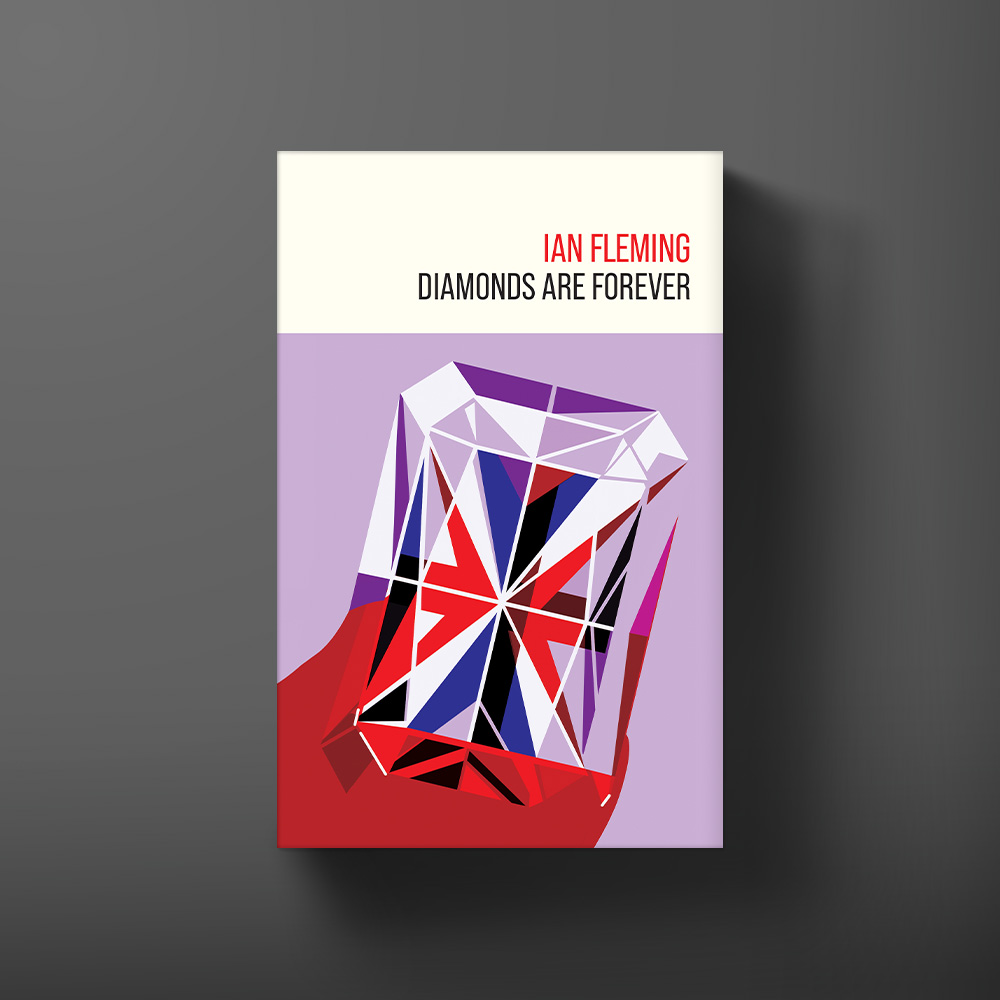
Hardback book cover for Diamonds Are Forever by Ian Fleming, designed by Michael Gillette.

Had he given you Casino Royale before or after the casino visit?

Oh after that. But Ian gave my father a copy of Casino Royale, a first edition, which he inscribed. In fact I’d love to track down this copy because it means a lot. It’s inscribed to my father and it says ‘Thank you for supporting me through the writing of these books’. If anybody out there knows where it is, I’d love to see if we can find a way of borrowing it back!

Finally, what is your favourite John Pearson book?

Well, I really do love this book. So I think I’ll just stick with that.

Learn more about the life and work of John Pearson here.

Opinion: The Importance Of Colonel Sun

Writer Tom Cull discusses Kingsley Amis’ Colonel Sun, the story behind the novel and its relationship with the film, Spectre.

‘So James, I am going to where you are, the inside of your head.’

So says Ernst Stavro Blofeld in the 2015 film Spectre. He proclaims that he is the architect behind the many ghosts of Bond’s past and if this line echoes for you, then you probably recognise it from the very first James Bond continuation novel, Colonel Sun, written by Sir Kingsley Amis CBE under the not-so-secret pen name of Robert Markham.

In 1968, four years after Ian Fleming’s death, Ian Fleming Publications (then Glidrose) asked Amis if he would be interested in writing a new 007 novel. He was already a popular author and shrewdly – on the commissioners’ part – was known to be a Fleming fan.

Amis understood the high and low art paradoxes that existed in Fleming and the literary snobbery that befell him within some of his social circles. Amis’ own steadfast appreciation of wine and beer; classical music and pop, the Classics and science fiction, motivated him to take time out to write a semi-serious literary criticism of Bond entitled The James Bond Dossier.

‘There’s a whole series of absurd critical judgements on Fleming’s books that need to be set right. Bond has been turned into a lush-living, snobbish, lecherous, sadistic corrupting Fascist… But if you read with care, you will notice for instance, that there is a strong, consistent moral framework to the books: Toughness, loyalty and persistence are the touchstones.’

This, coupled with Amis’ choice to teach Le Carré’s The Spy Who Came In From The Cold to students at Tennessee University demonstrates a lack of genre snobbery on his part. By delving this deeply into Fleming’s oeuvre, he was essentially attending a sort of Bond finishing school for authors. His first official mission would come quickly: Colonel Sun.

What works about Colonel Sun (originally called Dragon Island) – and which is true of the best continuation novels – is that Amis does not overtly impersonate Fleming, fall into pastiche or simply try too hard to match the originator’s style. Amis understood his own limitations in writing Bond as he documented in What Became of Jane Austen and other Questions in 1968. He couldn’t match Fleming for his great knowledge of technical minutiae, but he held detailed knowledge on diverse subjects – Lee Enfield rifles for instance – and more importantly, he understood the ideology of Bond.

You may wonder also if Amis’ own brand of humour worked its way into the novel as Fleming’s did. In part yes, but it is different from Fleming’s. Whereas Fleming’s dialogue often had a sense of the absurd and theatrical, Amis’ conversations have a more conversational rhythm and lightness of touch, seen for instance during Bond and Ariadne’s debate on Capitalism vs. Communism. The character of Litsas offers most of the light relief, as did many of Fleming’s supporting characters, but Bond does not play for laughs.

We also find a lower tech Bond, good with his fists and basic weaponry; Amis’ Bond was for men, not boys. Many of Fleming’s tropes are still there though. He plays golf (at Sunningdale) with Bill Tanner; drives a Bentley; lunches at Scott’s, that sort of thing.

Yet, Amis acknowledged the need to provide the reader with reassuring touch points to avoid any immediate dissonance with a fervent audience. Few of these things Amis did in his private life either:

‘Golf – a game I hope fervently to go to my grave without once having had to play – was there in the first sentence.’

M is given an expanded role and the backdrop is a reassuringly exotic: the Greek Islands. And like all of Fleming’s best novels, we get a brilliantly insidious master villain – the Chinese Colonel Sun Liang-Tan. Kingsley’s son, the novelist Martin Amis approved:

‘Apart from the odd repetition or slightly inept term, the style is excellent. Just like Fleming.’

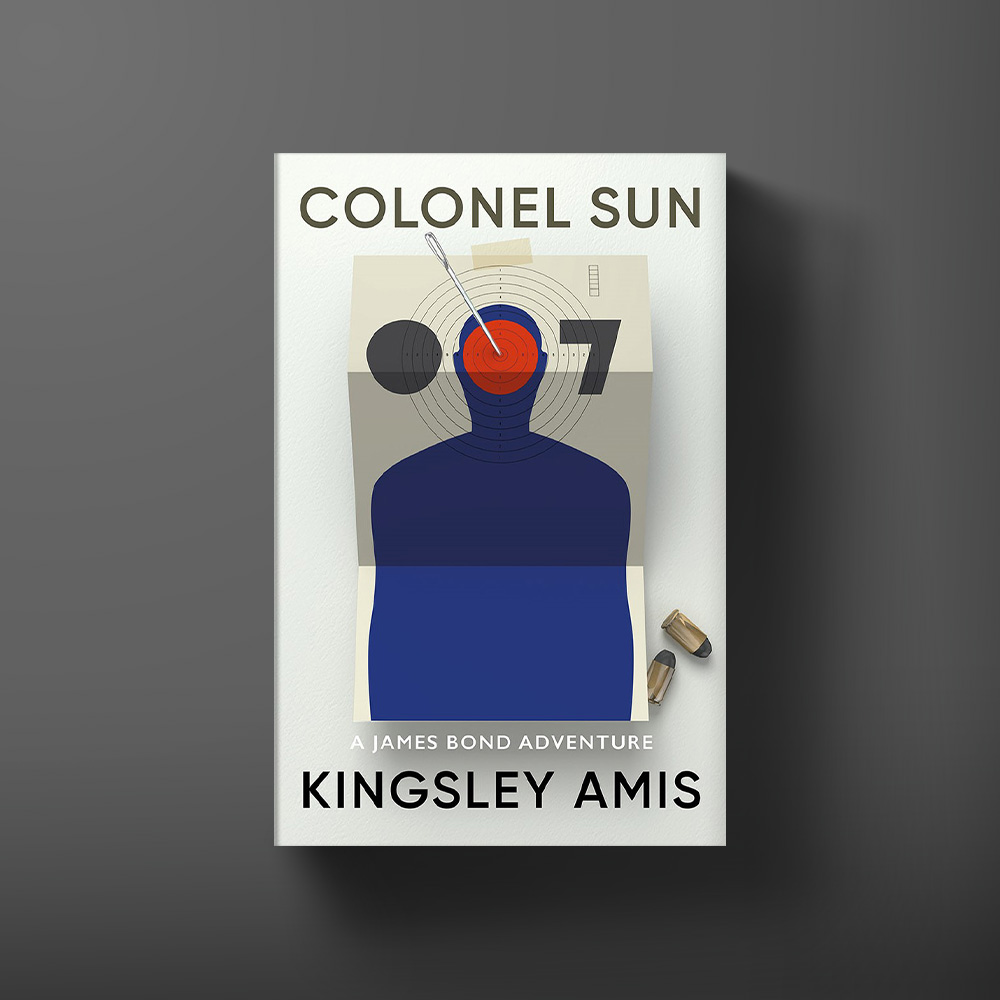
Paperback book cover for Colonel Sun by Kingsley Amis.

The torture in Colonel Sun is arguably the book’s pièce de résistance. Sun literally gets inside Bond’s head. In the chapter titled ‘The Theory and Practice of Torture’, Bond is strapped to a chair in a cellar and Sun provides Bond with what is almost an education on torture methods.

‘When an American prisoner in Korea was deprived of his eyes, the most astonishing thing happened. He wasn’t there anymore. He’d gone, though he was still alive.’

Readers who felt squeamish during Fleming’s Casino Royale torture scene will certainly want to brace themselves here.

‘So James, I am going to penetrate to where you are, to the inside of your head. We’ll make our first approach via the ear.’

But what caused Amis to station his Chinese super-villain in Greece? For one, Amis was conscious of not re-treading old Fleming ground, so Jamaica and the USA were out. Yet he needed to match Fleming’s expert attention to detail, so a sojourn to the friendly islands of Ios and Naxos gave Amis enough time to gen up on the scenery and local food and drink, to add enough of what he coined ‘The Fleming Effect’. Bond eats manouri cheese; drinks light Mamos retsina and also Votris, the ‘only drinkable’ Greek brandy according to Litsas.

As for choosing a Chinese villain, Amis was again keen to avoid re-hashing any of Fleming’s villains, save perhaps for Dr. No who was Chinese-German, as Amis recanted:

‘Red China as a villain is both new to Bond and obvious in the right kind of way.’

Obvious perhaps, because by 1965 relations were strained between China and the rest of the world – and in particular Russia during the Sino-Soviet split, resulting in border clashes. Amis would have been conscious of this and also of how attitudes in Britain during the ’60s were changing. Another shift from the Fleming formula was to team 007 up with a female Russian agent. A whisper of From Russia with Love but with the notion that the Cold War against the Soviet Union was thawing as Bond suggests to Ariadne:

‘If they’re telling you there that the United States is world enemy number one, they need to catch up on their studies. The Kremlin knows perfectly well that the main threat isn’t the West any more, but the East. Surely that’s not news to you?’

Amis was brave enough to mould his own Bond while paying homage to its creator. With Colonel Sun, he set the benchmark for future continuation novelists and proved that Fleming’s Bond universe does welcome guests.

Tom Cull runs Artistic Licence Renewed. He knew iconic Bond cover artist Richard Chopping well as a child and Tom’s great grandfather hired a young Ian Fleming to work at the family bank Cull & Co. between 1933 and 1935.