Interview: Fergus Fleming

We speak to Fergus Fleming about his inspiration for his book, The Man with the Golden Typewriter, his developing view of his uncle Ian Fleming, and some of the correspondences he discovered while researching.

Why did you start the project?

A book of Ian’s letters was long overdue and, somewhat rashly, I raised my hand. Even more rashly, the offer was accepted.

Can you tell us more about Ian Fleming’s golden typewriter?

The golden typewriter was Ian’s great joke to himself. Just imagine his glee when it arrived in all its glittering splendour (smuggled in from America by his friend Ivar Bryce to avoid taxes). Serious-minded contemporaries considered it the height of vulgarity, but Ian didn’t care. Let them sneer! He had a golden typewriter and they didn’t. The machine in question was a Royal Quiet De Luxe and cost the princely sum (then) of $174. It wasn’t the only one in the world: the Royal Typewriter Co. produced a small run of them as an advertising gimmick. They were often given away as sports prizes or to favoured employees. None, however, have achieved the same iconic status as Ian’s. In 1995 an unknown bidder – rumoured to be Pierce Brosnan – bought Ian’s Quiet De Luxe for a sum that has been calibrated by the Guinness Book of Records as the highest ever paid for a typewriter.

Did Ian use it for the Bond novels?  My impression is that he didn’t. It doesn’t seem to feature in any of the pictures of him at his desk. But who knows?  

How much did you know about your uncle’s works and legacy when you were growing up?

Ian’s books were on the shelves when I grew up, but I don’t remember them being held in particular reverence. As he said to Raymond Chandler, ‘[I] meekly accept having my head ragged off about them in the family circle’. My father was so horrified by The Spy Who Loved Me that he made my mother read it under a brown paper cover. His brother Peter was also a writer, and his books too were on the shelves. So it was just an accepted fact of life that our family wrote books.

But I will say this. When checking a fact in You Only Live Twice, I used an original copy. And there, all at once, was the excitement of it. The Chopping jacket, the typeface, the Cape logo, the smell, the feel of the paper, the price – 16s. net – and the memory of something you will never find in a bookshop today. For a moment I caught the thrill that Ian, and his readers, must have experienced when the latest Bond came out.

Do you have any favourites from the correspondences you went through?

One of the best is Ian’s apology to Mrs. James Bond. Her husband was an ornithologist whose book Birds of the West Indies happened to be on Ian’s desk in GoldenEye when he wrote Casino Royale. In 1961 she caught up with him and demanded an explanation.

‘Your husband has every reason to sue me in every possible position and for practically every kind of libel’

Ian replied, adding that he had chosen James Bond because it was plain, masculine and anonymous – unlike Peregrine Carruthers or some such. In recompense,

‘I can only offer your James Bond unlimited use of the name Ian Fleming for any purpose he may see fit. Perhaps one day he will discover some particularly horrible species of bird which he would like to christen in an insulting fashion.’

Did any of the letters mention ideas that he never used in his Bond books?

This is a sensitive matter that falls under The Official Publishing Secrets Act and as such I am not permitted to disclose the contents of any files that may or may not have come to my attention. That said, he did float the possibility of setting a Bond novel in Australia – which would have been interesting.

Did your opinion of Ian Fleming change after reading his correspondence and did you discover any new aspects of his character?

Ian has been portrayed so often in films and books as a callous, suave womaniser – in essence a mirror image of Bond – that I was prepared for something along those lines. To my surprise it didn’t materialise. Of course, this isn’t a biography and a fuller examination would probably confirm the accepted picture. All I can say is that his letters reveal a man who was witty, punctilious and kind, assailed by fits of self-doubt yet resolutely optimistic, who worked hard to make a living the best way he knew.

Do you think Ian was a true eccentric, or was the typewriter more a symbol of a persona he enjoyed cultivating as the writer of thrilling – and at times bombastic – fiction?

Ian wasn’t an eccentric. I would say he was more a romantic. He enjoyed turning dreams into reality and vice versa. He had an urge to tell stories. If he could make life a story – the martinis, the golden typewriter – then all to the good. If he could make a story out of life – to tell people what he saw, what he experienced, and how it inspired him – then so much the better.

‘Writing makes you more alive to your surroundings,’ he once said, ‘and since the main ingredient of living… is to be alive, this a quite a worthwhile by-product of writing.’ If writing made him alive, so did the imagination that underpinned it.

The Story Behind: The Diamond Smugglers

‘”There’s a big packet of smuggled stones in London at this very moment”, said M, and his eyes glittered across the desk at Bond’

On 15th September 1957, Ian Fleming’s true account of diamond smuggling in Africa was serialised by the Sunday Times. The articles were then bound together and published as a book the following year.  Sixty years on, we celebrate this fascinating piece of journalism which shows a side to Fleming’s writing career not often in the spotlight.

After a period studying in Europe, Fleming became a journalist in the 1930s for Reuters News Agency and covered stories such as the Metro-Vickers espionage trial in Moscow. After trying his hand at stockbroking and then working in Naval Intelligence during the Second World War, Fleming returned to journalism and became Foreign Manager at Kemsley News, owners of the Sunday Times. Fleming’s experience in journalism helped him to hone a quick and engaging writing formula which shaped his style as a thriller writer.

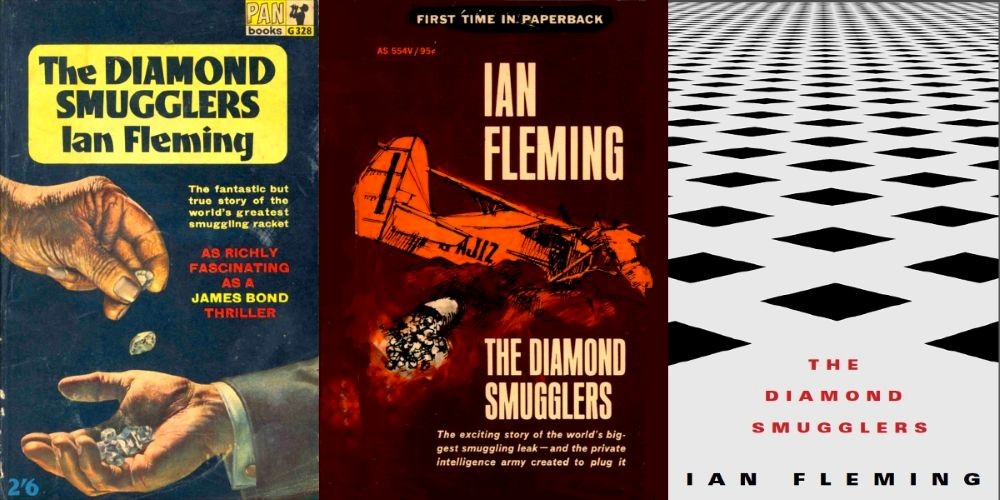
Paperback cover for The Diamond Smugglers by Ian Fleming.

Fleming first read a story about illicit diamonds leaving Sierra Leone in the Sunday Times in 1954. The article intrigued him and he was inspired to research it for the basis of one of his James Bond stories.  Diamonds Are Forever was published in 1956 and the following year, Fleming was invited to write an account of the experiences of a real-life diamond spy, resulting in The Diamond Smugglers

Here, Fergus Fleming, writer and Ian Fleming’s nephew, takes us behind the book.

When The Diamond Smugglers was first published Ian Fleming had a copy bound for his own library. On the flyleaf, as was his custom, he wrote a short paragraph describing its genesis. It started with the alarming words: “This was written in two weeks in Tangiers, April 1957.” As the ensuing tale of woe made clear, he didn’t consider it his finest fortnight. He ended with the dismissive verdict: “It is adequate journalism but a poor book and necessarily rather ‘contrived’ though the facts are true.”

It should have been a golden opportunity. The Sunday Times had acquired a manuscript from an ex-MI5 agent called John Collard who had been employed by De Beers to break a diamond smuggling ring. Fleming, whose Diamonds Are Forever had been one of the hits of 1956, was invited to bring it to life. Treasure, travel, cunning and criminality: here were the things he loved. Flying to Tangier – home to every shade of murky dealing – he spent ten days interviewing Collard, for whom he had already prepared the romantic pseudonym “John Blaize” and the equally romanticised job description of ‘diamond spy’.

The glister tarnished swiftly. He visited neither the diamond fields of Namibia or Sierra Leone, with which the story was primarily concerned, but sat in the Hotel Minzah typing up his notes. It rained constantly and he found the landscape dull. There was little scope for literary flair, his more extravagant flourishes being blue-pencilled routinely by Collard. When the final version was serialised by the Sunday Times in September and October 1957 further material had to be excised under threat of legal action by De Beers. “It was a good story until all the possible libel was cut out,” Fleming wrote gloomily.

Yet if The Diamond Smugglers was a disappointment to its author it still contains flashes of Fleming-esque magic. Amidst the Tangerian alleys he strays unerringly to the thieves’ kitchen of Socco Chico, “[where] crooks and smugglers and dope pedlars congregate, and a pretty villainous gang they are.” Travelling with ‘Blaize’ to the Atlantic coast, he encounters a forest of radio masts – still one of the world’s communication hubs – where they “could imagine the air above us filled with whispering voices.”

Later, as they walk down the beach they stumble (literally) on a shoal of Portuguese Men of War driven ashore by a storm. Alone on the tip of Africa, with the coast stretching 200 miles to Casablanca, the sea running uninterrupted to America, and a carpet of jellyfish beneath their feet, the two men conduct what has to be one of the most surreal interviews in history. “It amused Blaize to stamp on their poisonous-looking violet bladders as we went along,” Fleming wrote, “and his talk was punctuated with what sounded like small-calibre revolver shots.”

Today The Diamond Smugglers is one of Fleming’s least known works. But in its time it was one of his most commercially valuable. It sold in its hundreds of thousands. No sooner was it in print than Rank bought a film treatment for the princely sum of £12,500. (Further misery: he had to split the proceeds with Collard and the Sunday Times.) Nothing came of the project. But in 1965, by which time Fleming was dead and Bond a worldwide phenomenon, it flared briefly into life. Items concerning its progress featured in the press: a thrusting young producer had it in hand; John Blaize would emerge as a new Bond-like character; Kingsley Amis had been hired to write the script; the drama would be intense. After a while the announcements became slightly plaintive. And then they stopped.

More than forty years later it remains something of a conundrum; a journalistic chore that its author disliked but which nevertheless became a best-seller and very nearly his first film; a book that is neither travelogue nor thriller but combines the discarded hopes of both; a tale of international intrigue and exploding jellyfish that leads to the final question: “Who wouldn’t rather play golf?”

It is a wry, unplaceable thing, but all the more interesting for that. Certainly it doesn’t live up to Fleming’s self-damning critique. Take this sentence from the opening paragraph:

“One day in April 1957 I had just answered a letter from an expert in unarmed combat writing from a cover address in Mexico City, and I was thanking a fan in Chile, when my telephone rang.”

If you’re given a line like that you can only read on.

Fergus Fleming is the author of The Man with the Golden Typewriter: Ian Fleming’s James Bond Letters.