 Skip to main content
NEWS
How To Write A Book By Ian Fleming
BECOME A FLEMING INSIDER > JOIN HERE
How To Write A Book By Ian Fleming

Posted on 17 January, 2026
The start of a new year is the perfect time to jump into new creative endeavours, and if you’re looking to make progress on a book idea that’s been sitting in the back of a drawer, might we offer some advice from Ian Fleming himself. A master of his craft, this was how he approached writing a book a year:
‘Having assimilated all this encouraging advice, your heart will nevertheless quail at the physical effort involved in writing even a thriller. I warmly sympathise with you. I, too, am lazy. Probably rather lazier than you. My heart sinks when I contemplate the two or three hundred virgin sheets of foolscap I have to besmirch with more or less well- chosen words in order to produce a 60,000 word book.
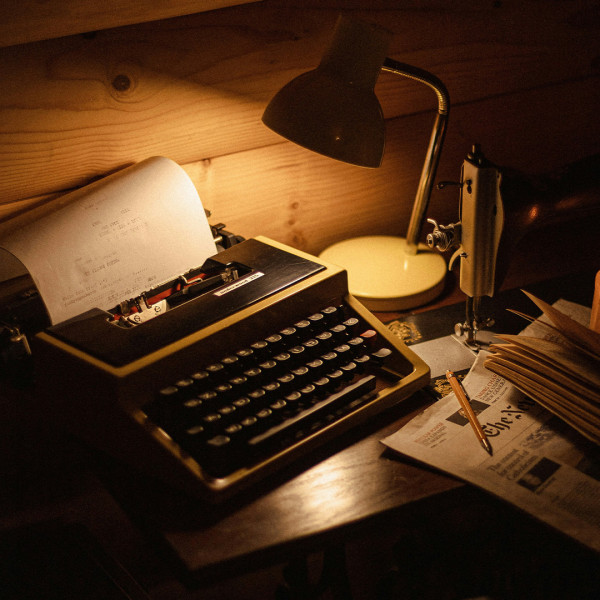
The method I have devised is this: I do it all on the typewriter, using six fingers. The act of typing is far less exhausting than the act of writing and you end up with a more or less clean manuscript. The next essential is to keep strictly to a routine – and I mean strictly. I write for about three hours in the morning – from 9.30 till 12.30 – and I do another hour’s work between 6 and 7 in the evening. At the end of this I reward myself by numbering the pages and putting them away in a spring-back folder. The whole of this four hours of daily work is devoted to writing narrative. I never correct anything and I never look back at what I have written, except to the foot of the last page to see where I have got to. If you once look back, you are lost. How could you have written this drivel? How could you have used ‘terrible’ six times on one page? And so forth. If you interrupt the writing of fast narrative with too much introspection and self-criticism you will be lucky if you write 500 words a day and you will be disgusted with them into the bargain.
By following my formula, you write 2000 words a day and you aren’t dis-gusted with them until the book is finished, which will be, and is in my case, in around six weeks.
I don’t even pause from writing to choose the right word or to verify spelling or a fact. All this can be done when your book is finished.
When my book is finished I spend about a week going through it and correcting the most glaring errors and rewriting short passages. I then have it properly typed with chapter headings and all the rest of the trimmings. I then go through it again, have the worst pages re-typed and send it off to my publisher.
They are a sharp-eyed bunch at Jonathan Cape’s and, apart from commenting on the book as a whole, they make detailed suggestions which I either embody or discard. Then the final typescript goes to the printer and in due course the galley or page proofs are there and you can go over them with a more or less fresh eye. Then the book gets published and you start getting letters from people saying that Vent Vert is made by Balmain and not by Dior, that the Orient Express has vacuum and not hydraulic brakes, and that you have mousseline sauce and not Béarnaise with asparagus.’
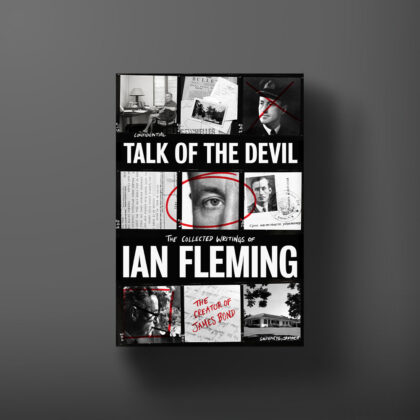
This extract was taken from ‘The Art, or Craft, of Writing Thrillers’, a transciption of a talk given to an Oxford student body in May 1962, and included in Talk of the Devil: The Collected Writings of Ian Fleming.