 Skip to main content
NEWS
Book Club Interview: Dr Pam Hirsch On The Lifeline
BECOME A FLEMING INSIDER > JOIN HERE

Book Club Interview: Dr Pam Hirsch On The Lifeline

Posted on 23 December, 2025
To round off the first month of the James Bond Book Club, we were delighted to discuss the fascinating life and work of Phyllis Bottome with Pam Hirsch, author of The Constant Liberal: Phyllis Bottome, (Quartet, 2020).
Please could you introduce yourself and your connection to Phyllis Bottome.
I am a retired Lecturer in Literature and Film at Cambridge University. I am also a biographer. There are three things that call out to the biographer in me: I am drawn to women who have been lost from sight, who were creative – writers, painters or dancers – and who were politically engaged on the liberal left. My parents both admired Bottome’s work, so physical copies of her books were part of their legacy to me. The neglect of her work is emblematic of other popular writers. Recently, there has been a concerted effort to remedy this, and there have been some lively academic conferences deliberately asserting the term ‘Middlebrow’, wishing to recuperate the term.

What are you particularly drawn to when it comes to this author?
Bottome was a significant chronicler of her times, publishing prolifically on politics, social issues, psychology and education. It is not surprising that she has been hard to pin down, in that she cannot be securely fixed with one particular literary movement, or even one particular epoch. Born in the late nineteenth century, her first novel was published when she was only twenty and she was writing and publishing up until her death aged eighty-one. Her career covers the years before the First World War, the inter-war years, and during and after the Second World War. She is unusual, too, because she cannot be tied down to one particular location. Brought up in both England and the United States of America, she lived for substantial periods in mainland Europe – in Switzerland, Austria, France, Germany and Italy – so she was exceptionally well informed in European affairs as well as being international in outlook. She had a most extraordinary life, affording her a wealth of unusual experience. Ironically, some of her ‘travel’ was because her survival was repeatedly threatened by tuberculosis occasioning the necessity of living in the mountains. It was in St. Moritz for example that she met her future husband, Ernan Forbes Dennis.
Could you outline the significance of Bottome’s commitment to the psychology of Alfred Adler?
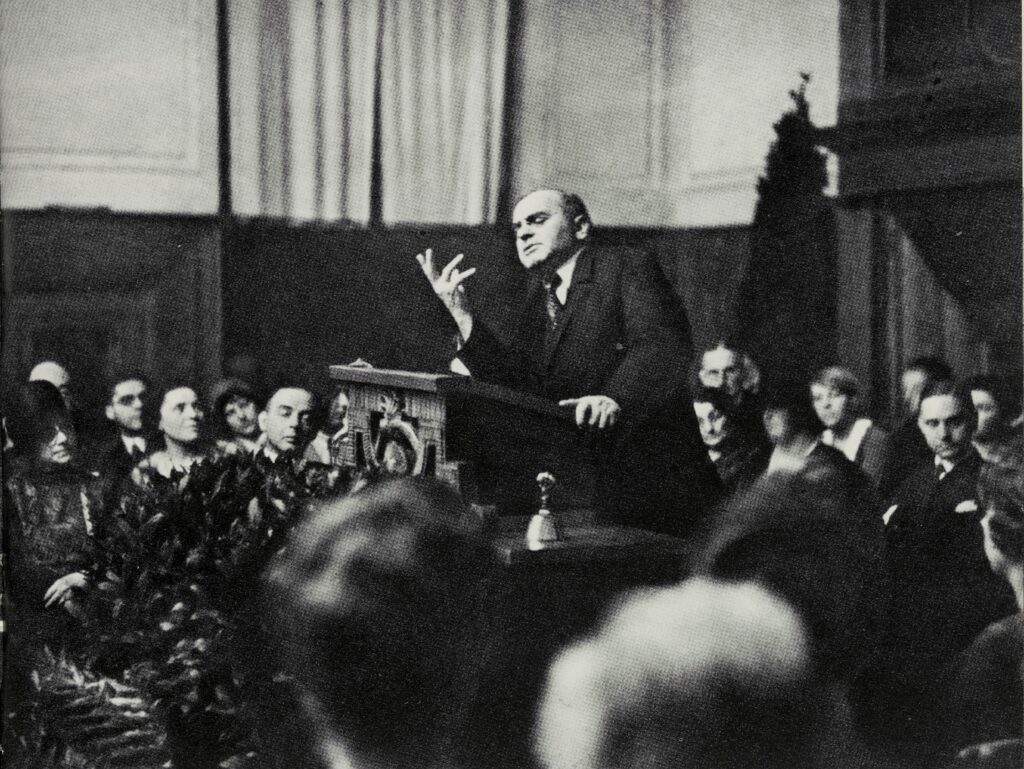
Vienna was the birthplace of psychoanalysis and its variants. From the 1920s both Bottome and her husband became drawn to the Individual Psychology of Alfred Adler. His understanding that a fully developed individual would find happiness through love, work and an integrated role in the community chimed with her liberal values. He developed ideas, too, about sibling rivalry and the significance of birth order. They both studied with Adler and became close friends: she later wrote his biography.
How do you think her understanding of the human mind influenced her work.
In 1920 Bottome went to war-ravaged Vienna with her husband who, after having been badly injured in the trenches of the First World War, had been trained in SIS (Secret Intelligence Service, now known as MI6) in Marseille. From this vantage point, as well as joining Viennese activists in organizing food and medical supplies in the starving city, she was able to watch the developing political situation. Her writing became increasingly more urgent as the future was challenged by significant political events, often asking what courage looks like under political pressure.
Can you tell us more about Tennerhof, the school run by Phyllis and her husband in the Austrian Alps? Why did they set it up, and what was life like there?
The resurgent threat of tuberculosis for Phyllis caused her and Ernan to leave both Vienna and Ernan’s successful career in Intelligence there, and move to the mountains. Ernan, who was fluent in French and German, decided to set up a school to teach adolescent boys. They rented a house called ‘The Tennerhof’, in Kitzbühel, a sleepy little Tyrolean market town, which was good for skiing in the winter. The boys studied hard with Ernan every morning learning languages and in the afternoons were free to go skiing or walking. Phyllis, as usual, was writing. In the evenings, Phyllis often played a ‘game’ with the boys of starting a story, and then each would take it in turns to add to it.
It turned out that one of the boys at the Tennerhof was Ian Fleming, sent there by his mother to prepare him for possible entry into the Foreign Office. Ian had been in endless trouble before his arrival, and even after it, though there seems little doubt that Ernan turned Ian around at a time when he might otherwise have gone completely off the rails. Ernan was a gentleman from Scottish aristocratic ancestry, which made him seem to Ian a little like the male Flemings, and, further, he had been tested in war. Like Ian’s father, he could be regarded as a war-hero, and Ian came to see Ernan as an idealized father-figure.
Following Adler’s theories, Ernan saw that he had to replace Ian’s self-defeating goal of being a failure [always comparing himself to his own disadvantage with his older brother, Peter] with a new goal that could lead to success. He encouraged Ian to work hard towards being accepted by the Foreign Service, and it may well have been that Ernan’s previous work in military intelligence made this seem a rather glamorous option.
Once again, Ernan was almost uniquely well-placed to advise Ian; neither he nor Phyllis had attended university but had both educated themselves in a kind of long-running reading group of two. Their own range of reading was eclectic and they were very much European, rather than merely English intellectuals. As Ian was to say later:
‘I remember in those days before the war reading, thanks to the encouragement of the Forbes Dennises, the works of Kafka, Musil, the Zweigs, Arthur Schnitzler, Werfel, Rilke, von Hofmannstahl, and those bizarre psychologists Weininger and Groddeck – let alone the writings of Adler and Freud – and buying first editions (I used to collect them) illustrated by Kokoschka and Kubin.’
Phyllis and Ernan remained friends with Ian throughout his life.
Do you agree with the argument that The Lifeline inspired Fleming’s James Bond?
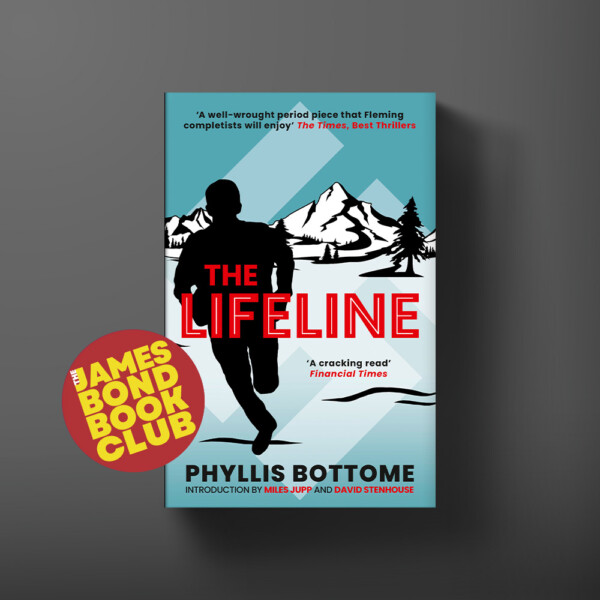
I am going to answer this by first giving a fairly detailed account of The Lifeline. It was her first book to be published immediately post-war in 1946 by Faber & Faber in Britain and by Little, Brown in America and was a study of the anti-Nazi underground forces in Europe. Its focus is what happens to a decent sort of educated Englishman, Mark Chalmers, a master at Eton, when faced with extraordinary circumstances. Until 1938, when the narrative begins, Mark Chalmers had believed that this public-school code was enough to live by:
Perhaps half of the boys went to Eton because their parents wanted them to be grand – and the other half because it was a family tradition to go there if you could. The boys that wanted to be grand – if they were like their parents, and it had to be remembered that boys very often weren’t – did pick up all Eton’s strange faults and absurdities; its isolationism; its defensive arrogance; its inconsiderate insolence; and its deep unconscious selfishness.
Mark found, after a briefing by the British Foreign Office, that he started to consider what Eton made of its boys, compared with what Hitler had made of the Hitler youth leaders. Hitler had airily stated that an English public school was the best training-ground for Nazi doctrines.
Certainly, a sense that one’s own nation was superior to any other, and an assumption that therefore it was its right to control an empire, was true of both Germany and Britain.
Mark has had little experience of thinking about the wider world. It is only as a consequence of his annual walking holidays in Austria and being able to speak good German with an Austrian accent that landed him in the unexpected position of being recruited as a spy by his chum Reggie in the Foreign Office. Parachuted into Austria after the Anschluss his cover is to pass as a manic-depressive in an asylum run by Dr. Ida Eichhorn. Waiting with Father Martin, a monk who is his intermediary contact in the resistance movement, Mark watches as:
‘a slight, hatless figure in knee breeches, with a short blue canvas coat, scrambled over the rocks towards them. She was, Mark saw with disapproval, as she came nearer, exactly the kind of woman he didn’t like. Her thick untidy ginger-coloured hair was cut close to her head, her face was inordinately white; she had not painted her lips, and she had the cold wild eyes of a sea bird. Her figure was wiry and without curves; she had no allure; no poise.’
Mark is thirty-six years old and his experience of women is limited; in particular, he is not used to dealing with a woman who regards herself as his intellectual equal. As Ida points out to him, his trajectory of a preparatory school, public school and Oxbridge education is roughly equivalent to living in ‘a cloister from ten to twenty [as a consequence] he retains, in a certain portion of his brain, a one-sex world’. Phyllis always expressed her distaste for any regime that keeps women as second-class citizens; although it was a significant feature of Nazi Germany, she is also pointing out that educational reforms would be necessary for post-war Britain.
Initially, like many upper-class Englishmen, Mark has not regarded the regime in Germany as necessarily a bad thing, although he was upset by the occupation of his favourite country. It is Father Martin who makes him understand what to live under a Nazi regime really means:
“Do not think that Hitler is not prepared as well for a long war as for a short one! His whole country is permanently organized on a war footing. You do not know what that means. You who tie gasmasks to your cricket bats, and still depend on horses and greyhounds to lift your untutored hearts! Remember and tell your people – the Germans are trained not only technically but spiritually for murder! Anti-semitism is not a folly – it is an atrocious process – the Nazis manufacture cruelty – against defenceless Jews – so that a whole people may be ready to accept murder as a pastime without physical damage to themselves. The Jew is the trial rabbit on which to whet the appetite of the German nation towards destruction”.
The novel is amongst other things a Bildungsroman in that Mark begins the book thinking that he is ‘exactly the kind of man he wanted to be’, but has to reform his complacent concept of masculinity. Ida, the Adlerian psychologist acts as the provocateuse who re-educates him.
The novel exploits Gothic elements to make these points. Michael Salvatore, Ida’s former lover, is an insane aristocrat whom Ida keeps in top security within the asylum, which has once been his Schloss. In Phyllis’s novel, the mad creature locked away is not a wife, but a once glamorous and sensually attractive man. A further Gothic element, reminiscent of Oscar Wilde’s Portrait of Dorian Gray is the formal portrait of Salvator who Mark perceives as being ‘the handsomest man he had ever seen’. Mark’s Doppelgänger is finally revealed to him as ‘a great, shaggy hair-grown figure [running] to and fro on all fours, very nimbly and tirelessly in spite of age, as if he were the wolf he now thought he was’. Mark’s initial admiration of the fierce hyper-masculinity of Salvator as represented in his portrait, is now lost as Salvator is revealed as not-fully-human. This theme, a critique of hyper-masculinity, arises from a clearly chartable feminist literary tradition. The nineteenth-century French woman writer George Sand explored it in her novel, Mauprat, which, along with her other novels, was closely studied by both Charlotte and Emily Brontë. The representations of the wolf-like tendencies of both Rochester in Jane Eyre and Heathcliff in Wuthering Heights, before their moral education has been effected, can each be regarded as, to some degree an homage to their favourite woman writer. Phyllis may or may not have read George Sand, but she was devoted to the work of the Brontë Sisters, so is picking up on this powerful trope. Utilising this particular form of feminist Gothic, Phyllis adapts it to make a compelling psychological analysis of the connections between a perverse form of masculinity and fascism. By the end of the narrative, Mark’s personal re-education causes him to eschew this form of masculinity and his political education means that he realises that not only have England and America their own internal problems, but also that they have been blind to their world obligations.
Throughout the novel there are examples of upper-class Austrians, such as Ida, and also peasants, such as the Planer family, who are in resistance to the Nazi spirit. But Phyllis also shows how some upper-class Austrians had bought into the deadly fascist ideology. In representing Salvatore as a fascist who believes that he is a werewolf, the psychological affinity with Hitler is clearly signalled. Phyllis creates an embodied metaphor to stand for the anti-human insanity of fascism. When interviewed about the book, she said:
‘I invented the werewolf […] as part of the logic of the Nazi system. You see their logic is composed of fear, lies, force and hate. The direction is death. The werewolf is a killer going towards death. Unless we have an opposite logic of courage, truth, freedom and love which leads towards life, we are in danger of becoming Nazi. We must train ourselves.’
Writers, she said, more than ever, must be the world’s peacemakers.
So, in answer to the question of whether I think The Lifeline was a direct influence on the creation of James Bond, I would say probably not. In a 1962 interview in The New Yorker Ian Fleming said, ‘When I wrote the first one in 1953, I wanted Bond to be an extremely dull, uninteresting man to whom things happened’. This suggests, perhaps, that Fleming had been initially tempted to create a character like Phyllis’s. Certainly, Phyllis’s publishers always sent a copy of her novels to him, so he would certainly have read The Lifeline. But Fleming’s Bond is depicted as a professional Intelligence agent; Fleming after all had served in Intelligence during World War II, so could draw on his own experiences. And Bond was glamourous; quite possibly Fleming thought that this was what the reading public needed during the drabness of post-war Britain, with coal and some foods still being rationed. Nor is Fleming concerned [or rather Bond], as Phyllis is, with the equality of women. And lastly, and connected with the last point, Phyllis is warning about the potential for fascist tendencies in Britain and its Empire. Bond, I think, only represents concern about the diminution of Britain’s Empire.
However, what Fleming owes to Bottome, as well as his love and respect, is what he learned from her at the Tennerhof. She would always encourage the boys to try their hands at writing and would always read and critique their stories. She mentored the apprenticeship writing of Ian Fleming, Nigel Dennis and Ralph Arnold, for example. In particular, she taught Ian how to write page-turners, as she herself did. When Phyllis died, in 1963, Ian wrote to Ernan:
‘She was such a dear person and between you, you spread an extraordinary warmth and light and sympathy wherever you went. You were father and mother to me when I needed them most and I have always treasured the memory of those days in Kitzbühel.’
If you could only recommend one other book by Phyllis Bottomme, what would it be and why?
The Mortal Storm, published in 1937 in the UK and in 1938 in the USA. It was a searing and psychologically convincing novel showing what fascism means, first to a German family, then to Jews and ultimately to freedom itself. MGM bought the rights to turn it into a film and it was MGM’s first openly anti-Nazi film to be screened in isolationist America.
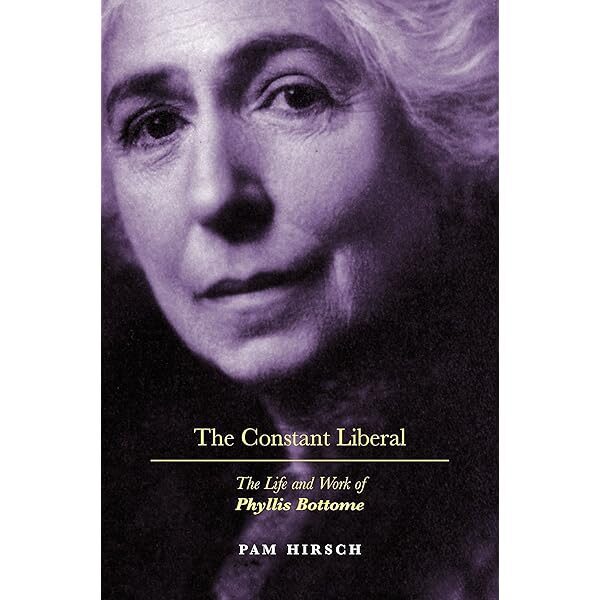
Our thanks to Dr Pam Hirsch for answering our questions. Read more in her biography of Phyllis Bottome, The Constant Liberal, here.
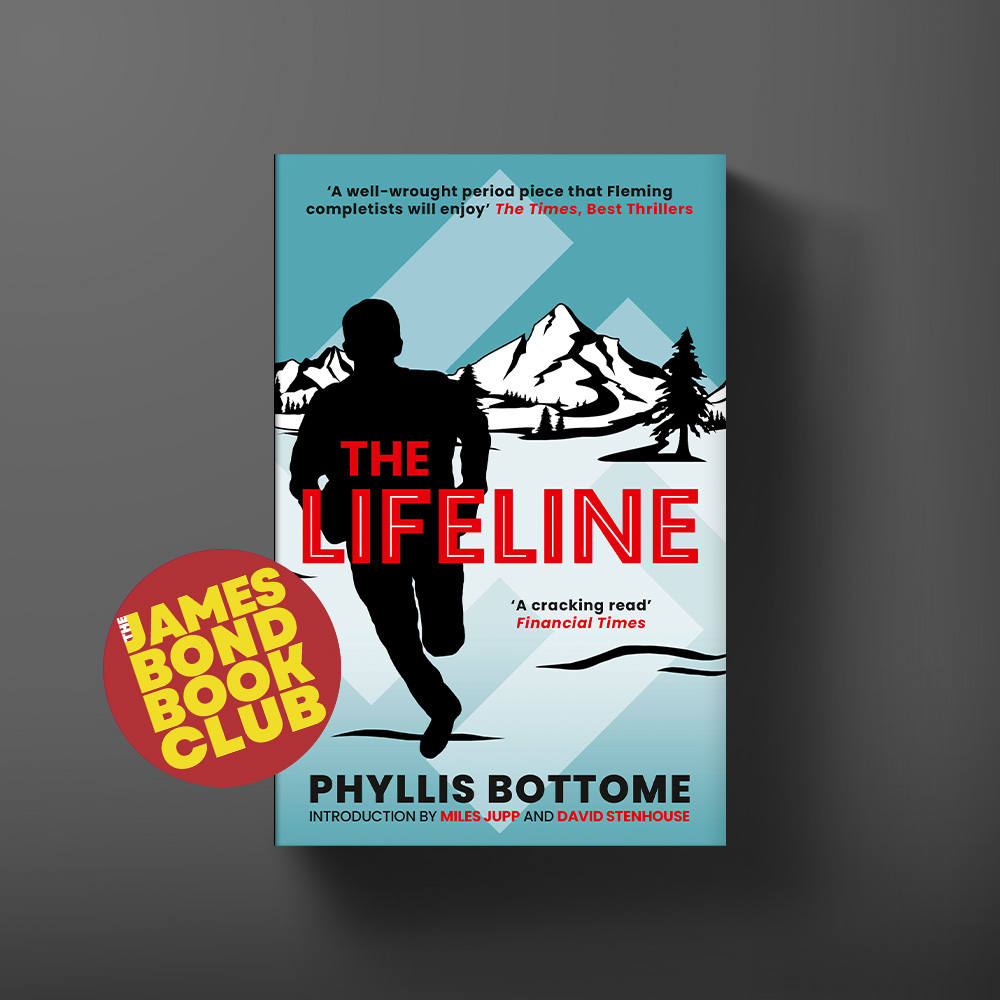
The Lifeline is the first James Bond Book Club pick. Find out more about why we picked it here, and get your copy at the Ian Fleming Shop here.